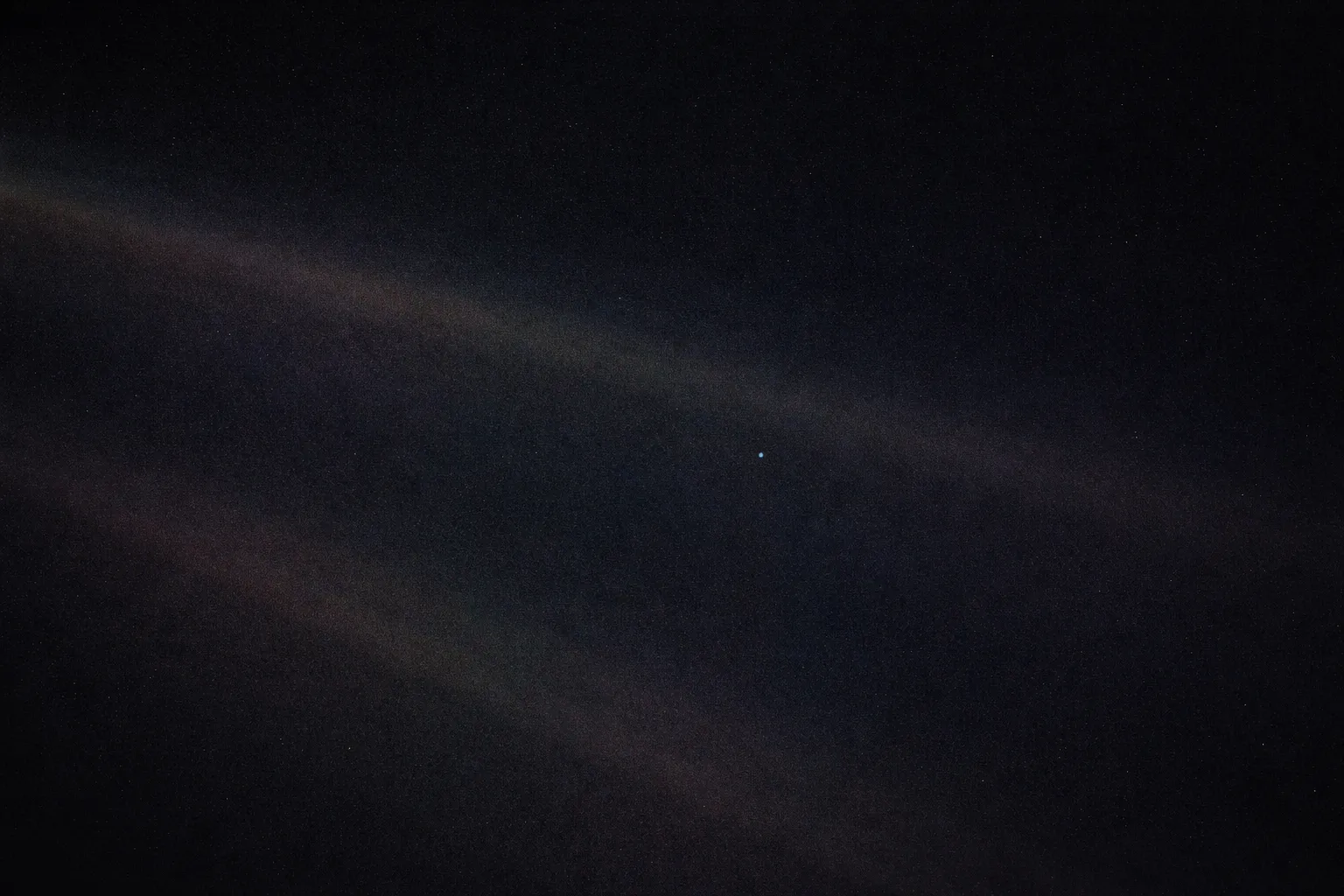
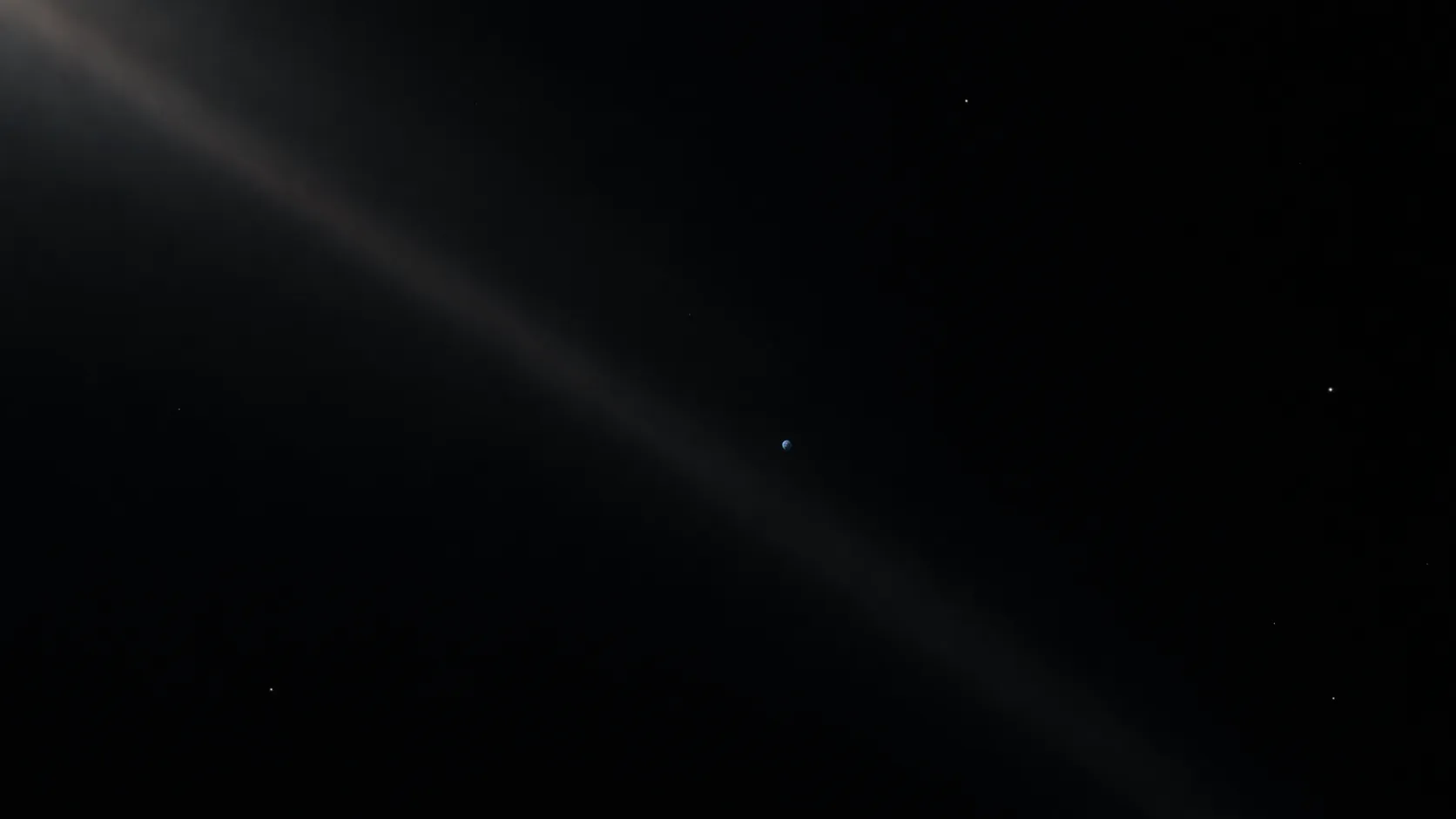
On February 14, 1990, a spacecraft 6 billion kilometers from Earth pointed its camera back at the solar system and took a portrait. It captured 60 images of 6 planets, stitched into a mosaic that NASA released later that year. In one of the frames, barely visible against a scattered ray of sunlight, was a point of pale blue light. It was Earth. It was us.
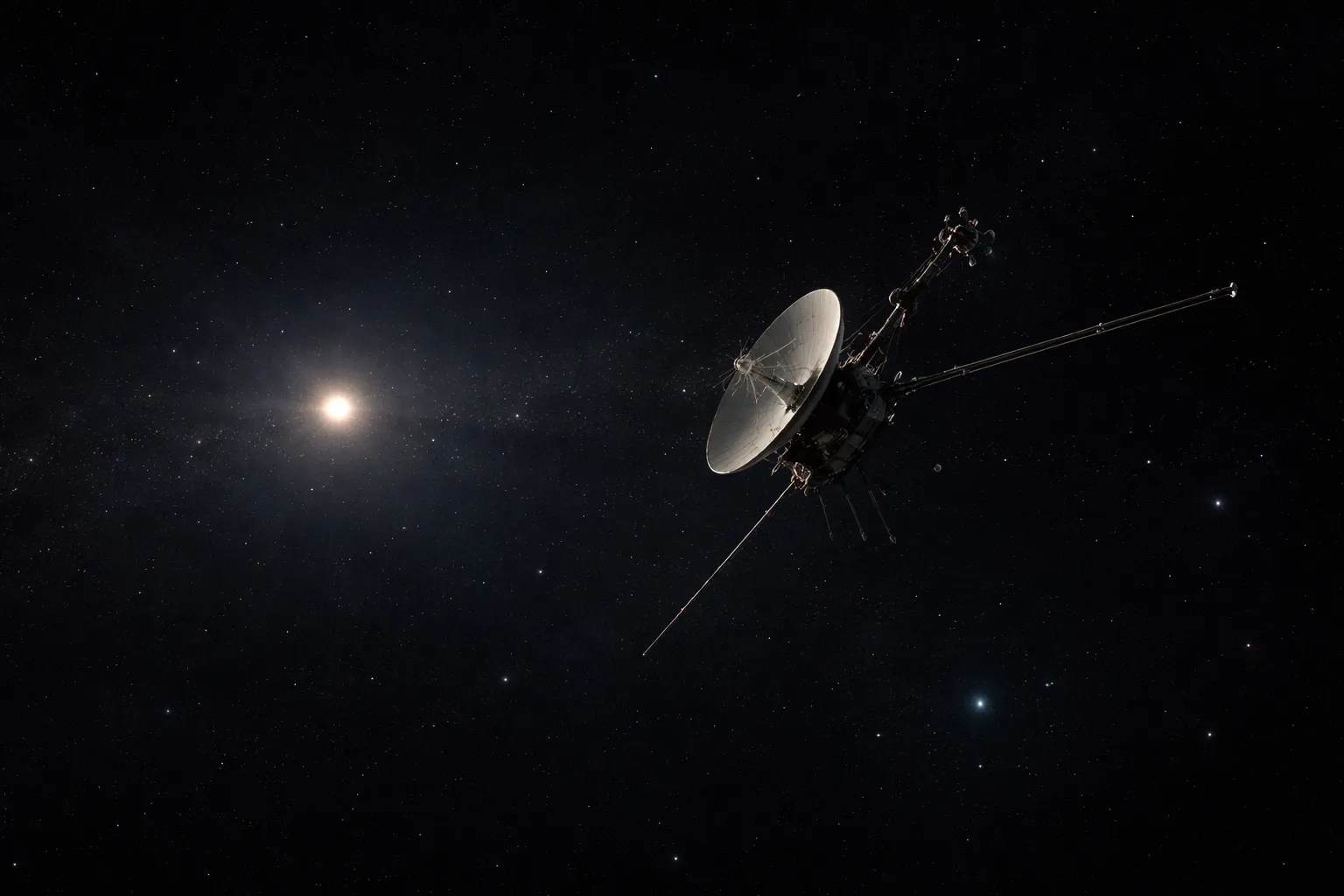
The photograph almost didn’t happen. Voyager 1’s camera system had been turned off years earlier — there was no scientific need for it after its primary planetary encounters. Carl Sagan, who had worked on the Voyager project from the beginning, campaigned inside NASA for years to turn it back on, take one final portrait, and then shut the cameras down for good. Engineers worried about the risk. The Sun could potentially damage the camera optics. Some thought it was a waste of resources.
Sagan argued that the image would have a different kind of value. Not scientific value exactly, but something harder to quantify.
Look again at that dot. That’s here. That’s home. That’s us.
He was right. When Sagan gave a lecture at Cornell in 1994, he used the Pale Blue Dot image as his central exhibit for an argument about human smallness and human responsibility. The transcript of that lecture was later published as the opening of his book on the same subject. The passage has been read by more people than almost anything else written about space exploration.
What Voyager 1 Actually Is
Voyager 1 was launched in September 1977, seventeen days after its twin, Voyager 2. Both spacecraft were designed to take advantage of a rare planetary alignment that occurs once every 175 years, allowing a single trajectory to visit multiple outer planets using gravitational assists. Voyager 1 flew past Jupiter in 1979 and Saturn in 1980, then headed out of the solar system entirely.
By the time the portrait was taken in 1990, Voyager 1 was already beyond Neptune’s orbit. It would not enter interstellar space — officially crossing the heliopause, the boundary of the Sun’s influence — until 2012. At that point, it became the first human-made object to reach interstellar space.
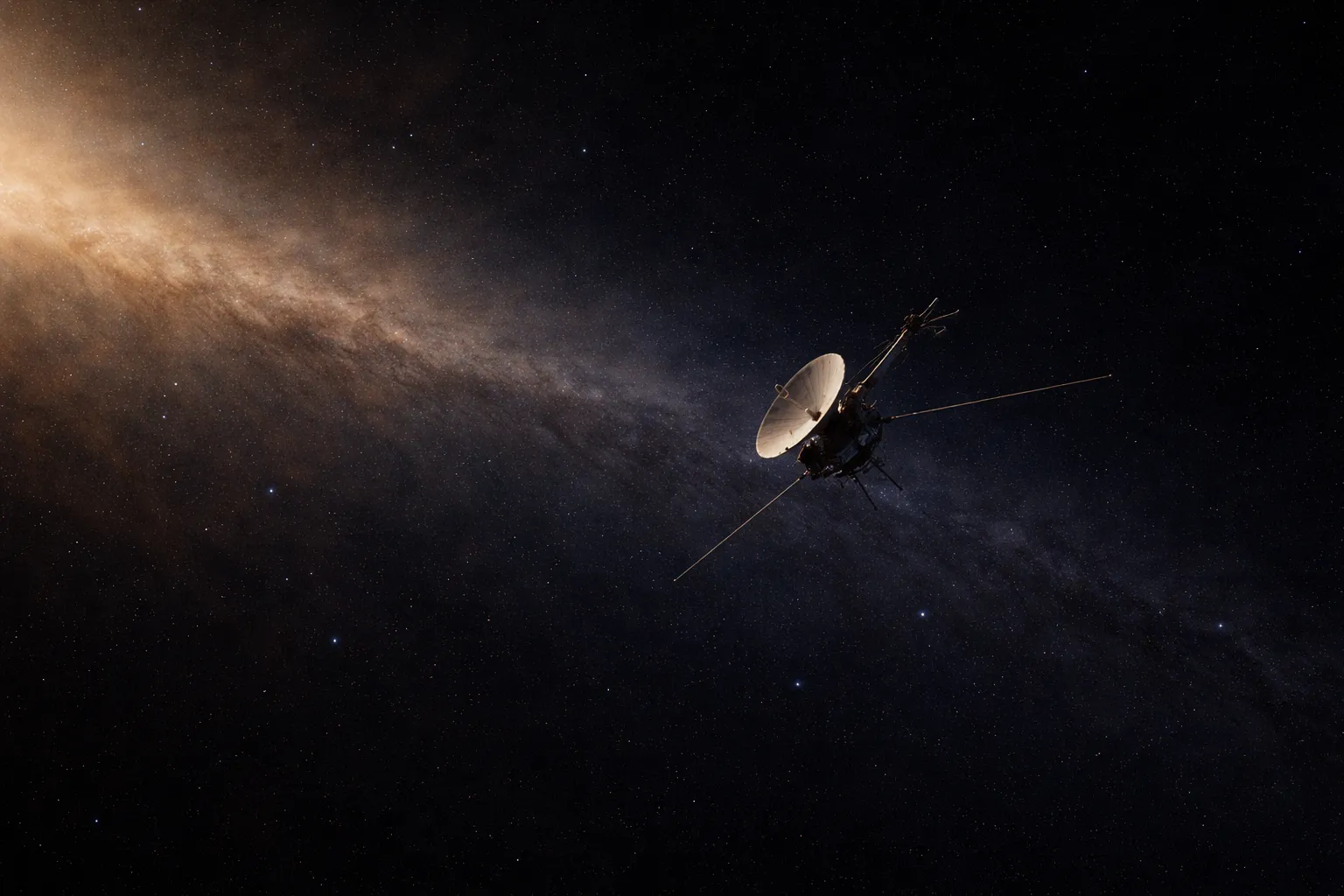
As of 2026, Voyager 1 is more than 24 billion kilometers from the Sun. A signal sent from Earth takes over 22 hours to reach it. The spacecraft still operates, powered by a nuclear source that loses about 4 watts of power per year. NASA estimates it will continue to return data into the 2030s before its systems finally go quiet.
The Mathematics of Insignificance
What makes the Pale Blue Dot photograph different from other space images is not technical quality — the resolution is poor by any standard. Earth is less than a single pixel wide. What makes it different is what it represents in its plainness. There is no grandeur in the image. Earth is not majestic. It is tiny. It is indistinguishable from noise except that we know exactly which pixel it is.
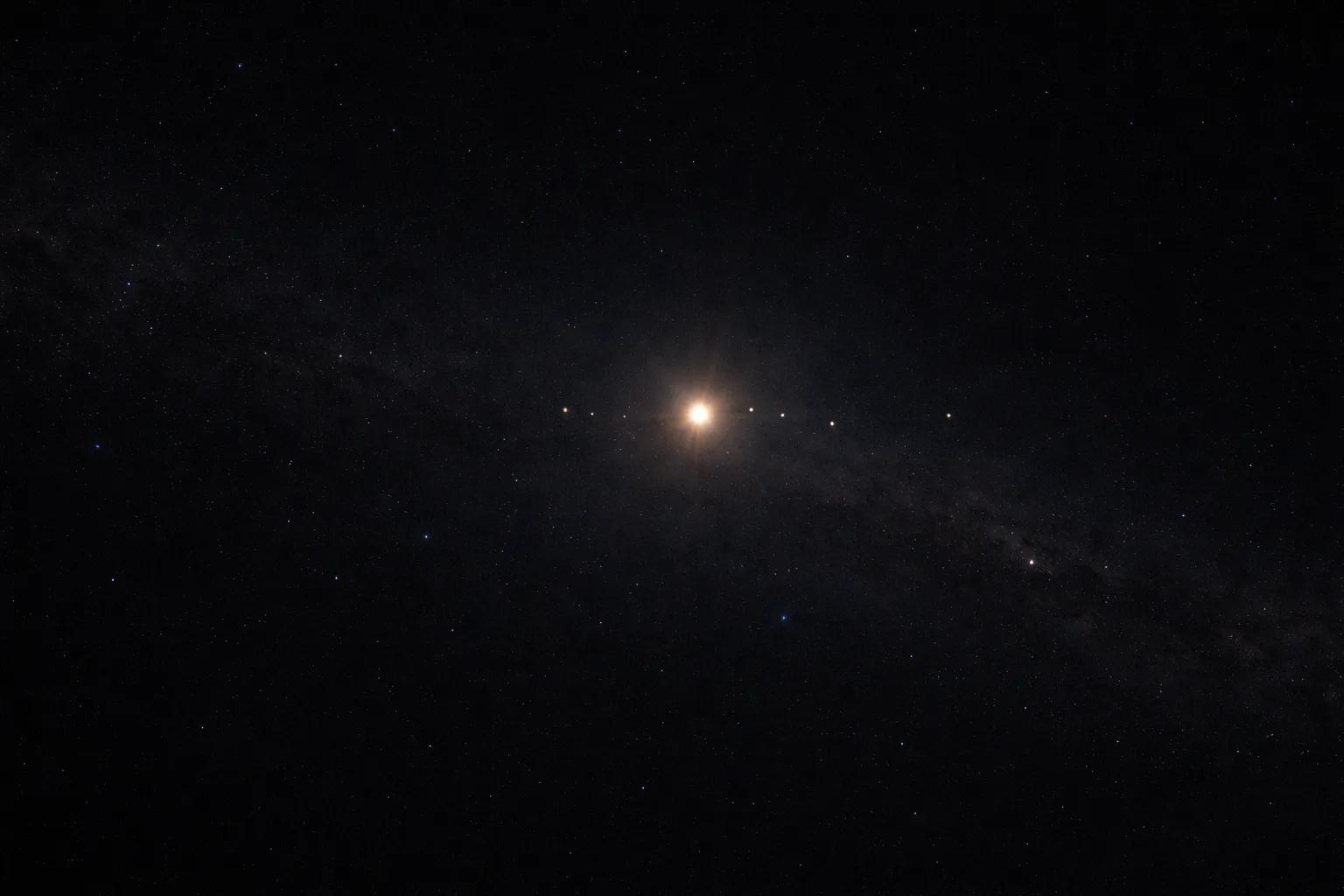
The average distance from Earth to the Sun is about 150 million kilometers. The distance at which Voyager took this photograph was 40 times greater than that. By that point, the Sun itself appeared as just another bright star. Everything humanity has ever built, fought over, celebrated, or mourned occupies a fraction of a pixel in a photograph taken from a spacecraft moving at 17 kilometers per second through empty space.
This is not a depressing thought, though it can feel like one at first. Sagan’s argument — and it is a genuinely coherent argument, not just a rhetorical flourish — is that recognizing our smallness should make us more careful, not more nihilistic. We have no other planet to go to. We have only each other. The Pale Blue Dot is not a reason for despair. It is a reason to pay attention.
Why This Still Matters
The Pale Blue Dot was taken over 35 years ago. Since then we have put more telescopes in space, landed rovers on Mars, detected gravitational waves, and imaged a black hole directly. Each of these accomplishments has expanded the picture of what we know the universe to contain. None of them has made Earth seem larger.
In 2020, NASA released a remastered version of the Pale Blue Dot using modern image processing. The new version is slightly clearer, the colors more accurate. Earth is still a pale blue dot. The remastering required no new data — everything it needed had been sitting in an archive for 30 years, waiting for better tools.
That is perhaps the most human thing about the image. The picture was there all along. The meaning was there too. It just needed someone to look at it carefully enough to say something true.