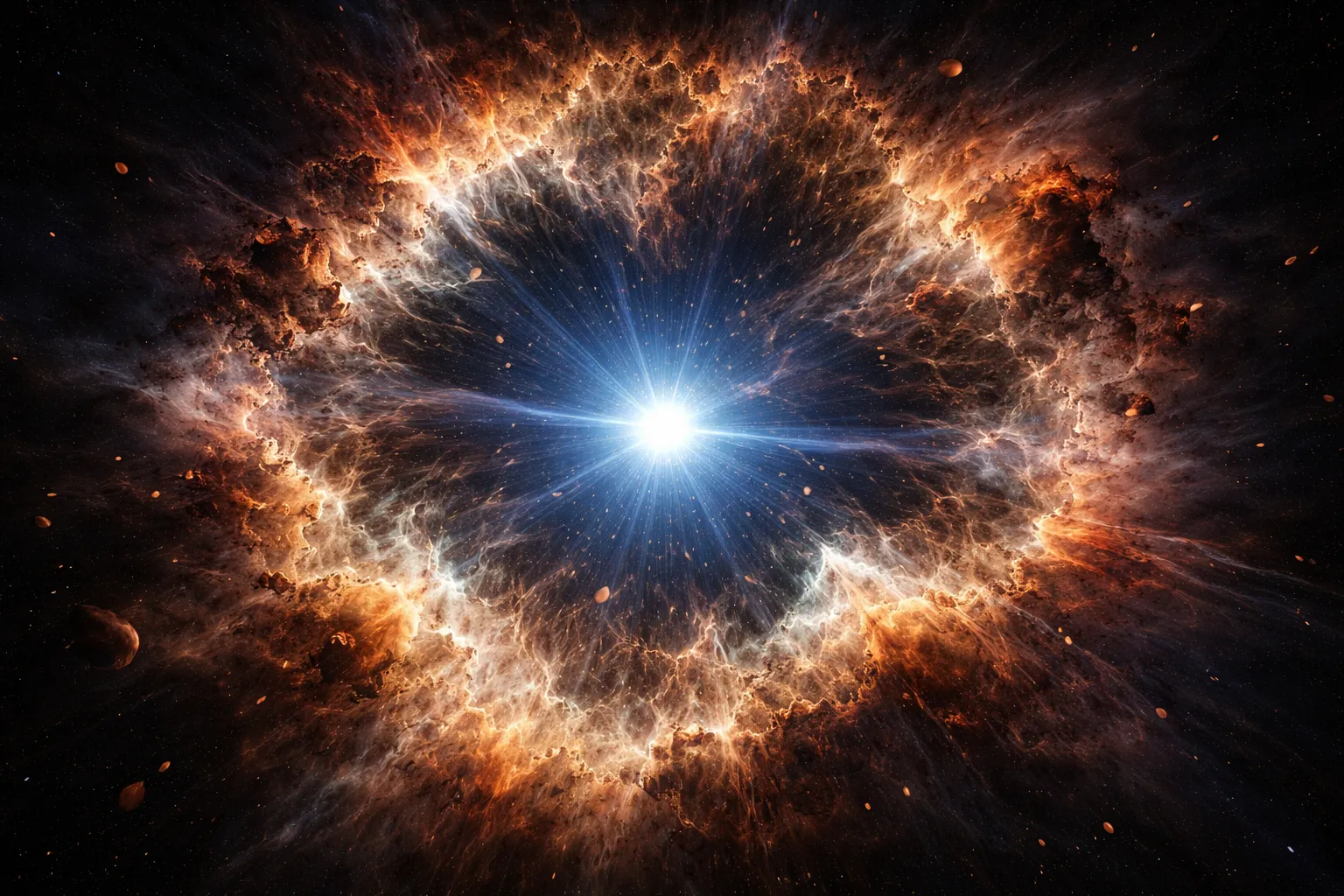
When a massive star dies, it does not always leave behind a black hole. Sometimes gravity wins just enough to crush the core into something almost impossible to picture but not enough to hide it behind an event horizon. The result is a neutron star: a city-sized object carrying more mass than the Sun and packing matter so tightly that ordinary atomic structure no longer survives.
Matter at its limit
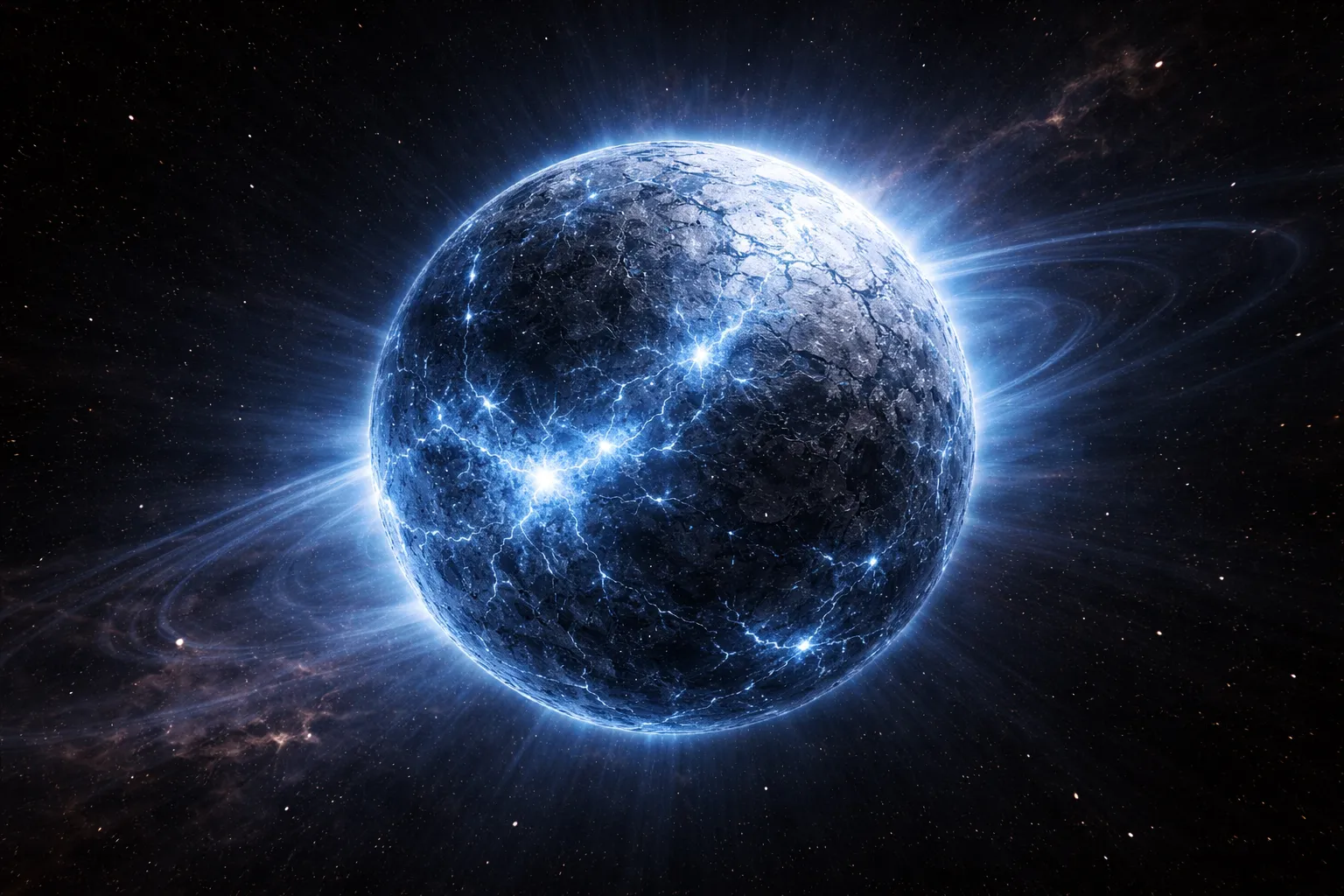
The name comes from the idea that protons and electrons are pressed together until matter becomes dominated by neutrons. A teaspoon of neutron-star material would weigh billions of tons on Earth. That comparison is dramatic, but it is not just a fun fact. Neutron stars are one of the few places where physicists can study what matter does under crushing density, intense magnetism, and extreme gravity.
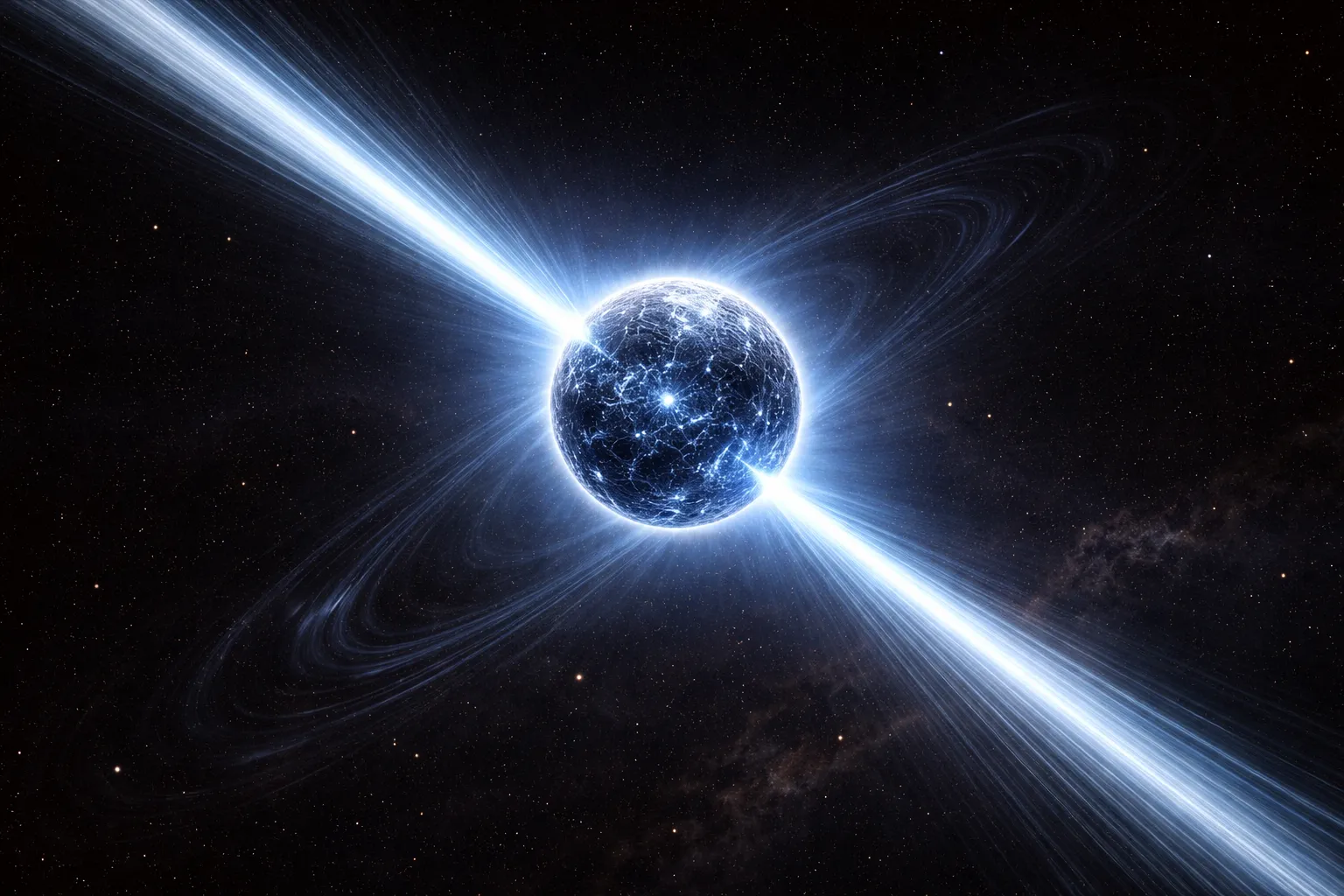
Some neutron stars spin rapidly and beam radiation like lighthouses. These are pulsars, discovered in 1967, and they became so precise that astronomers could use them as natural clocks. Others carry magnetic fields so strong that they power violent bursts of energy. Even within one class of object, the universe found room for variety.
Why astronomers care so much
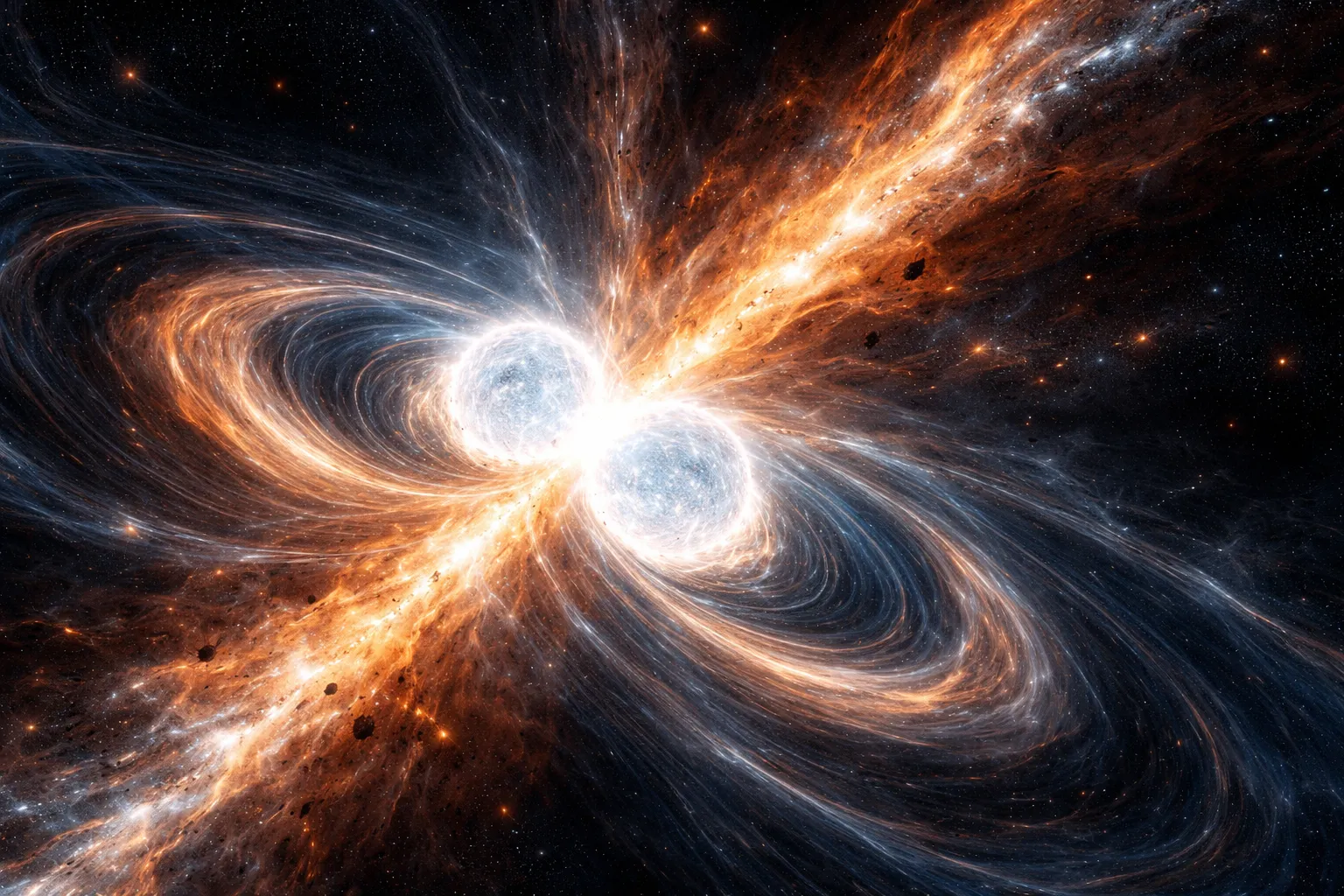
Neutron stars sit at a useful boundary. They are more extreme than ordinary stars, but unlike black holes, they still have surfaces and internal structure that can in principle be studied. That makes them laboratories for the equation of state of matter, for relativity, and for the origin of heavy elements. When neutron stars collide, they can create gold, platinum, and other heavy nuclei while also sending gravitational waves across the universe.
So neutron stars matter for a simple reason: they show what the universe does when matter is pushed almost as far as it can go without disappearing from view. They are not black holes, but they are close enough to the edge to teach us where the edge is.