Sometime around 1950, Enrico Fermi was eating lunch with colleagues at Los Alamos and the conversation turned to extraterrestrial life. Fermi listened for a while, then asked a question that nobody at the table had a satisfying answer to: “But where is everybody?”
The question has since become one of the most unsettling problems in science. Not because we don’t have answers — we have too many. The problem is that almost none of them are reassuring.
The Numbers That Started the Problem
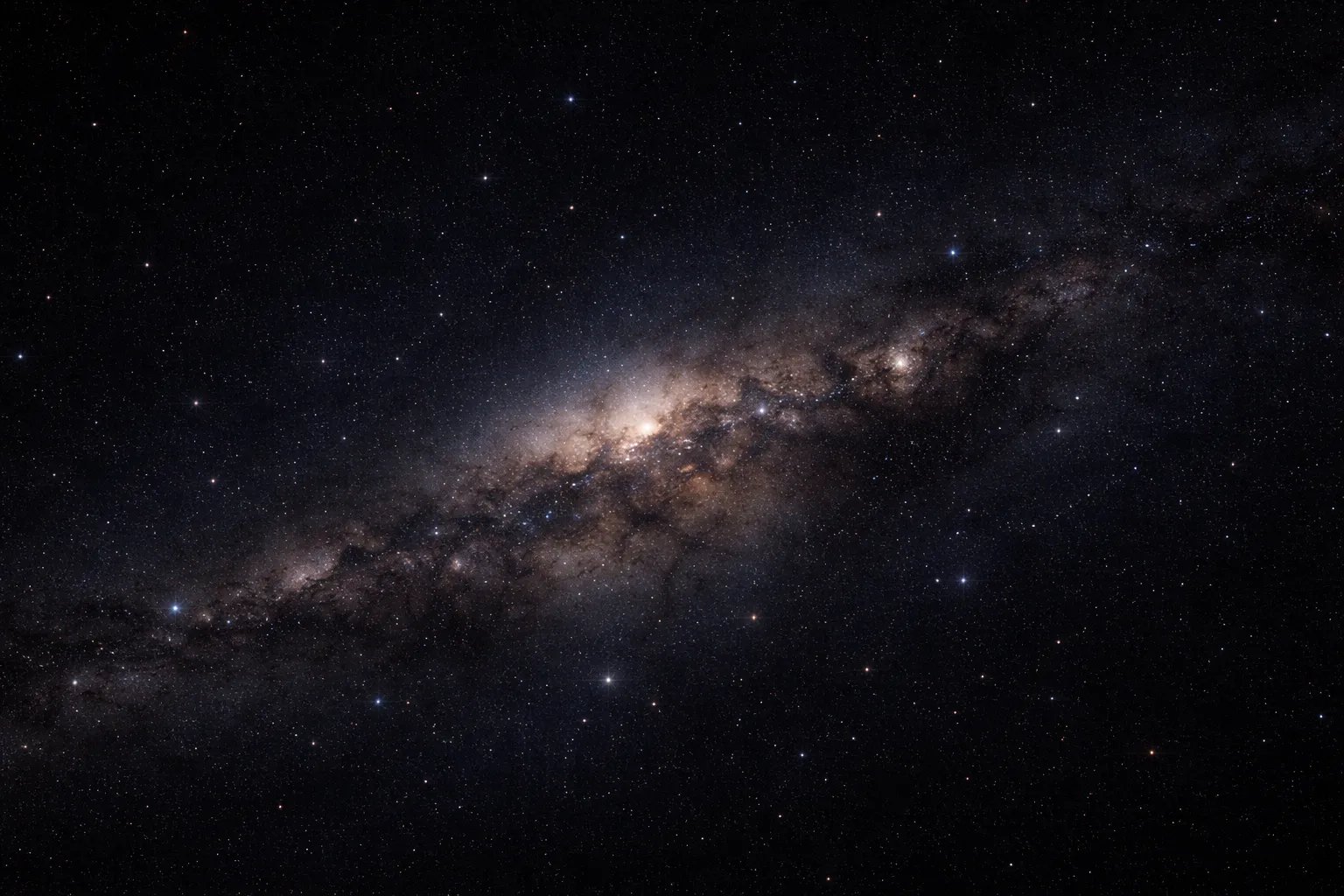
The Milky Way galaxy contains somewhere between 100 and 400 billion stars. Observations from the Kepler Space Telescope suggest that most of these stars have planets, and that a significant fraction of them are rocky planets in habitable zones where liquid water could exist. Conservative estimates put the number of potentially habitable planets in our galaxy alone in the billions.
The galaxy is also about 13 billion years old. If life formed on even a small fraction of those habitable worlds, and if any of it developed into technological civilization, those civilizations would have had extraordinary amounts of time to spread. Even at speeds far below the speed of light — at 1 percent of the speed of light, for instance — a civilization could colonize the entire Milky Way in about 10 million years. That sounds like a long time. On a cosmic scale, it is nothing.
And yet. No confirmed signal. No artifacts. No visitors. Nothing but silence.
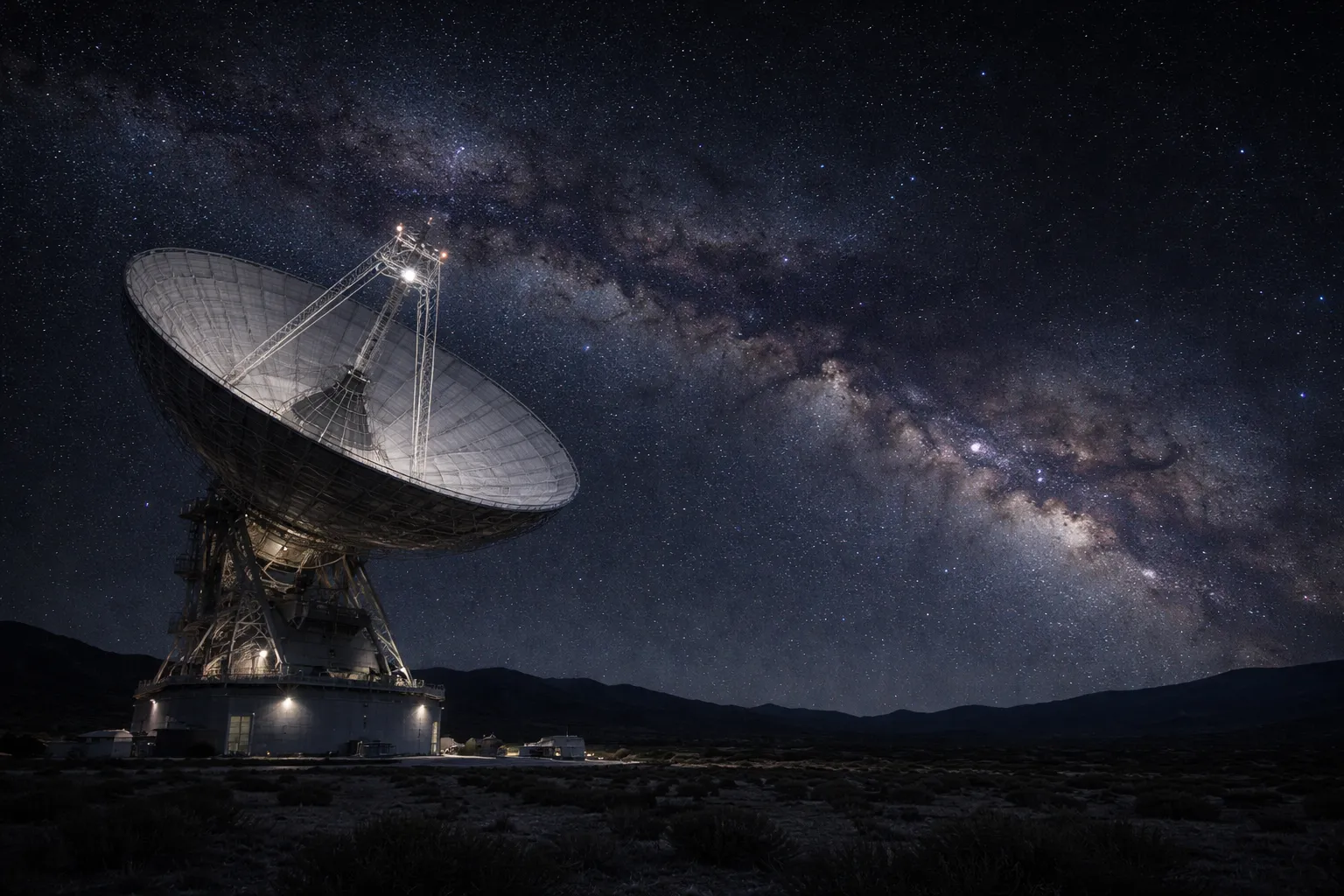
The universe is 13.8 billion years old. The silence is not absence of evidence. It might be the most important evidence we have.
Proposed Explanations
There are dozens of proposed resolutions to the Fermi Paradox. They range from the mundane to the existential. Here are the most seriously discussed ones.
We are not listening in the right way. We have been searching primarily for radio signals because that is what we can detect. But an advanced civilization might have moved to lasers, neutrinos, gravitational waves, or something we haven’t invented yet. Our search so far has covered a tiny fraction of possible frequencies, directions, and signal types. The absence of a signal in a narrow search band is not absence of a signal everywhere.
Interstellar travel is simply too hard. Even a civilization a million years older than ours might find that crossing 100,000 light-years is not worth the cost. Colonization of the entire galaxy might not be a thing civilizations actually do, regardless of their capabilities. If they stay close to home, the galaxy stays quiet.
They are out there and they are not interested in us. We assume a sufficiently advanced civilization would want to communicate or expand. We might be projecting our own values onto a vastly different kind of mind. A civilization that has existed for 500 million years might have priorities we cannot begin to imagine.
The Dark Forest Theory
One of the darker explanations — popularized by the Chinese science fiction writer Liu Cixin — is what he calls the Dark Forest hypothesis. The idea is that the universe is like a dark forest: every civilization is a hunter, moving silently, because any civilization that reveals itself risks being destroyed by another civilization that cannot afford to take chances. In this model, the silence is not an accident. It is a survival strategy. Every civilization that broadcast its location has already been eliminated.
This theory is not taken seriously by most scientists as a literal explanation, but it illustrates something important: we don’t actually know that announcing ourselves to the galaxy would be safe. Stephen Hawking argued, reasonably, that contact between civilizations of vastly different technological levels has historically gone badly for the less advanced party. He recommended caution.
The Great Filter
Perhaps the most sobering resolution is the concept of the Great Filter, proposed by economist Robin Hanson in 1998. The argument is simple: something prevents intelligent life from reaching the stage of galaxy-wide colonization. Either most species never develop intelligence, or intelligence never develops technology, or technology always destroys itself before it can spread.
The question that matters is where the filter sits relative to us. If it is behind us — if the hard part was developing life, or eukaryotic cells, or multicellular organisms, or brains — then we may be rare but not doomed. If the filter is ahead of us, then every civilization hits it eventually. The silence of the galaxy would then be evidence not of absence but of extinction — a graveyard whose graves are too small and too distant for us to see.
When we search for signs of life on Mars or in the oceans of Europa and find nothing, that is actually a comfort of sorts. It suggests the filter is early — that life doesn’t form easily — which means we might be past it. The more terrifying scenario is finding life easily, everywhere. That would move the filter forward, and we would need to explain why none of it ever made it this far.
What We Actually Know
We have been actively searching for extraterrestrial signals for about 65 years, beginning with Frank Drake’s Project Ozma in 1960. We have scanned millions of stars. We have heard nothing confirmed, though there have been candidates — most famously the Wow! signal of 1977, which was never repeated and never explained.
The search continues. In 2016, Breakthrough Listen launched what is the most comprehensive SETI program ever funded, scanning one million nearby stars and 100 galaxies with two of the world’s largest radio telescopes. So far, nothing. But the search has barely begun in any meaningful sense.
The honest answer to Fermi’s question — where is everybody? — is: we don’t know. That is not a failure. That is the beginning of serious inquiry. The silence might mean we are alone, or it might mean we are early, or it might mean the universe is more dangerous than it appears. Each of those answers would tell us something profound about what we are and what we should do next.