In 1998, two competing teams of astronomers were racing to answer a simple question: how fast is the universe slowing down? Everyone expected it to be slowing down. Gravity pulls things together. The Big Bang had set everything moving outward, but gravity should have been decelerating that expansion over time. The only question was by how much.
Both teams found the same unexpected answer: the universe is not slowing down. It is speeding up. Something is pushing everything apart, and that push is getting stronger over time.
The discovery won the Nobel Prize in Physics in 2011. The force responsible was called dark energy. And over two decades later, we still don’t know what it is.
The Evidence
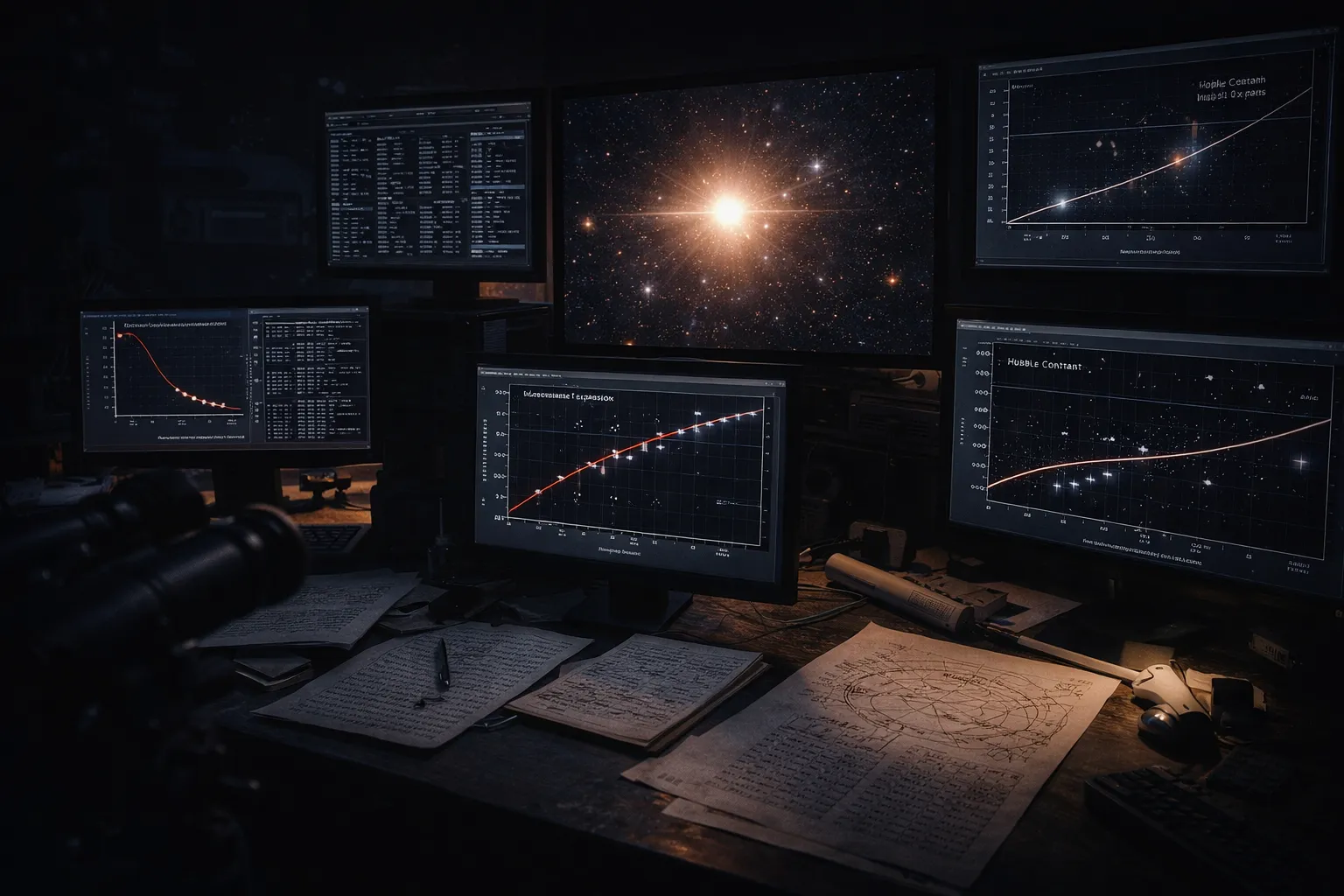
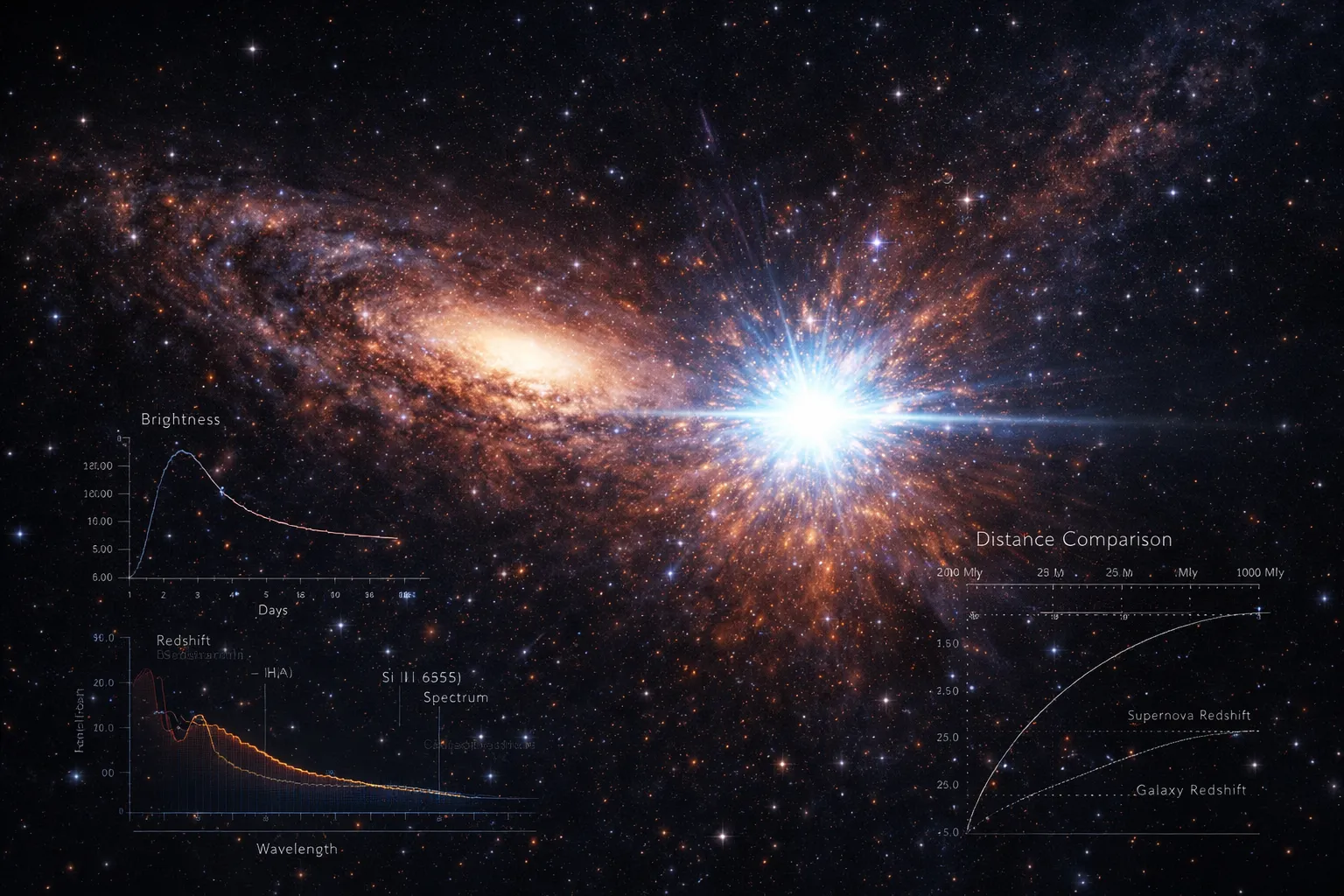
The measurement that revealed dark energy used Type Ia supernovae as what astronomers call “standard candles.” A Type Ia supernova is the explosion that occurs when a white dwarf star reaches a specific mass threshold and collapses. Because they all detonate at the same mass, they all produce the same amount of light. This means that if you see one that looks dim, it is not because it was a smaller explosion — it is because it is farther away.
By comparing how bright these supernovae appeared versus how far they should be based on their recession speed (measured through redshift), both teams found that distant supernovae were dimmer than expected. They were farther away than the standard models predicted. The universe had expanded more than it should have. Something was adding energy to the expansion.
Dark energy makes up about 68 percent of everything that exists. We have not directly detected it once.
What the Numbers Say
The current best model of the universe describes its contents as roughly 68 percent dark energy, 27 percent dark matter, and only about 5 percent ordinary matter — the stuff that makes up stars, planets, gas clouds, and everything you have ever seen or touched. The universe is mostly made of things we cannot directly observe or detect.
Dark energy is described in cosmological models through a single parameter called the cosmological constant, usually written as the Greek letter lambda. Einstein originally introduced this constant in 1917 to make his equations produce a static universe, because he thought the universe was static. When Hubble proved in 1929 that the universe was expanding, Einstein famously called the cosmological constant his greatest blunder. It turned out not to be a blunder. It turned out to be real, just not in the way Einstein had imagined it.
What It Might Be
The most common explanation is that dark energy is the energy of empty space itself — what physicists call vacuum energy. Quantum mechanics predicts that empty space is not truly empty but is instead filled with constantly fluctuating pairs of virtual particles that pop in and out of existence. This activity should generate a kind of energy that pushes space apart.
The problem is that when physicists calculate how much vacuum energy quantum mechanics predicts, they get an answer that is somewhere between 60 and 120 orders of magnitude larger than the value we observe. This is considered one of the worst predictions in the history of physics. The number we observe and the number we calculate are so different that the discrepancy is itself a deep mystery.
Other explanations include the idea that dark energy is not a constant at all but a dynamic field that changes over time — sometimes called quintessence. In this model, the strength of dark energy has varied throughout cosmic history and continues to evolve. In 2024, data from the Dark Energy Spectroscopic Instrument suggested some tension with the cosmological constant model, hinting that dark energy’s behavior might be more complex than a simple constant. The results were not definitive, but they pointed to a real question that future surveys will address.
What Happens at the End
If dark energy continues to accelerate the expansion of the universe at its current rate, distant galaxies will eventually recede faster than the speed of light — not because they are moving faster, but because the space between us is growing faster. They will become permanently unreachable. The observable universe will shrink as galaxies blink out of view one by one.
Eventually, in trillions of years, even the nearest galaxies will be too distant to see. Then, much further in the future, individual stars will fade. Eventually nothing that is not gravitationally bound together now will remain visible. The universe will be dark, cold, and vast beyond imagining.
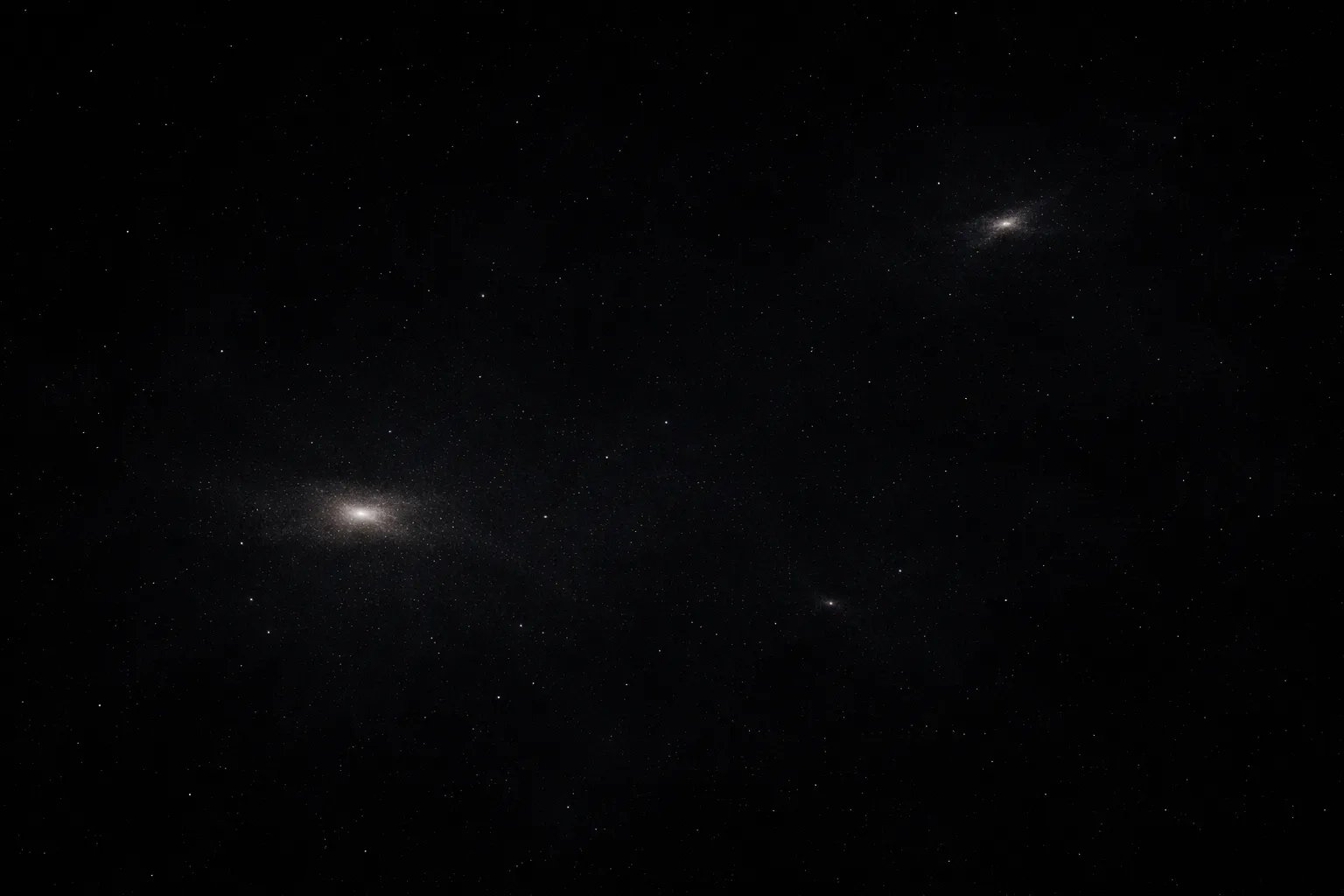
This is called the Big Freeze or Heat Death — the most likely long-term fate of the universe according to current models. It is not a cheerful ending, but it is worth knowing. The universe is not standing still. It is moving, and it is accelerating, and whatever is driving that acceleration is the dominant force in the cosmos. We named it dark energy because the name acknowledges what it is: energy we can infer but cannot see, doing work we can measure but cannot explain.